

Mycoplasma Contamination: The Most Hidden and Dangerous Threat in Cell Culture
- Addtime: 2026-04-07 / View: 2
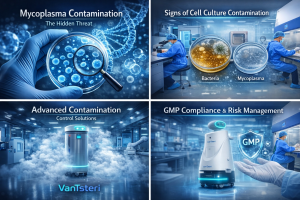
Vantsteri VHP disinfection robot provides system-level contamination control for mycoplasma and mold, compliant with GMP requirements
In cell culture and cell therapy environments, contamination is not always visible. Among all microbial risks, mycoplasma contamination is the most underestimated—and the most dangerous. Unlike bacteria or fungi, it does not cause obvious turbidity or rapid cell death. Instead, it silently alters cell behavior, making it one of the leading causes of unreliable experimental data and compromised product quality.
Mycoplasma are unique microorganisms. They lack a cell wall, are extremely small, and can pass through standard filtration systems. Because of these characteristics, they can persist undetected in cell cultures for long periods. In many cases, cells appear morphologically normal while their biological functions are already significantly altered.
The real danger lies in its impact on cell biology. Mycoplasma contamination can lead to reduced cell growth, altered metabolism, chromosomal instability, and changes in gene expression. For research laboratories, this results in inconsistent or misleading data. For cell therapy and GMP manufacturing environments, it directly threatens product safety, batch release, and regulatory compliance.
Sources of mycoplasma contamination are often underestimated. Common routes include laboratory personnel (oral and respiratory flora), contaminated cell lines, and infected reagents such as serum. Once introduced, mycoplasma can spread easily through routine operations and cross-contaminate multiple cultures.
One of the most critical challenges is detection. Because mycoplasma contamination does not produce visible signs, routine monitoring is essential. Methods such as PCR testing, DNA staining, or culture-based assays are typically required to confirm its presence. Without a structured monitoring strategy, contamination can persist unnoticed for weeks or even months.
In many facilities, contamination events are handled reactively—cells are discarded, and work restarts. However, this approach does not address the root cause. From a contamination control perspective, mycoplasma presence is not an isolated issue; it is often a sign of systemic weaknesses in aseptic practice, material control, or environmental management.
Effective control requires a structured approach: identifying contamination sources, implementing validated decontamination methods, and establishing a long-term microbial control strategy. Space-level decontamination technologies, such as vaporized hydrogen peroxide (VHP), can play a critical role in eliminating hidden contamination within complex environments.
At Vantsteri, we focus not only on removing contamination but on helping facilities build sustainable contamination control systems. By combining microbial analysis, source tracing, environmental treatment, and system optimization, we support laboratories and GMP facilities in achieving stable, compliant operations.
Mycoplasma contamination does not always destroy your cells immediately—but it can invalidate everything you produce. Recognizing and controlling this hidden threat is essential for any serious cell culture or cell therapy operation.